Bruschetta & Crostini: The Difference & Delicious Recipes
|
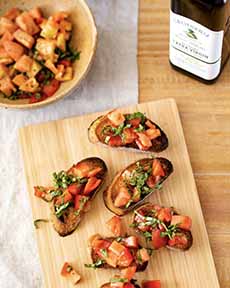
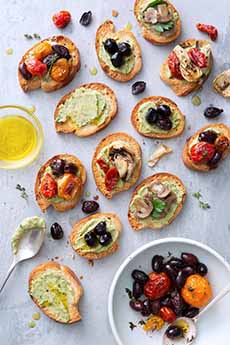
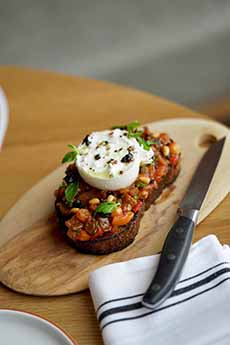
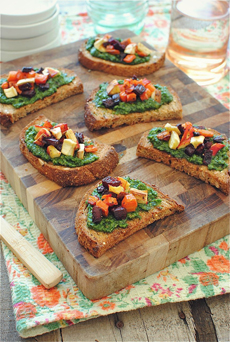
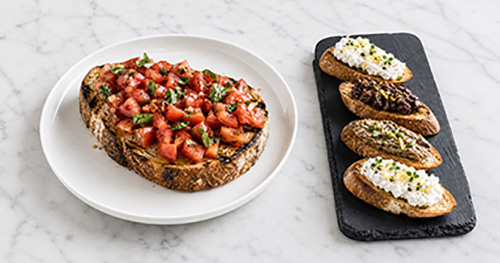
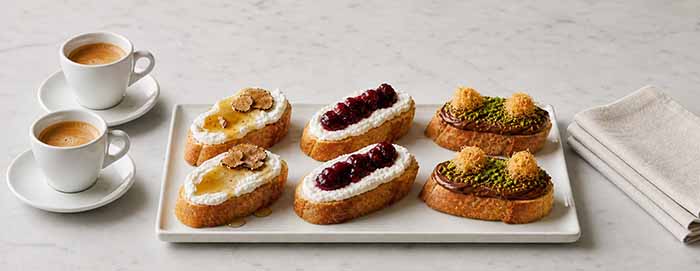
Bruschetta and crostini are two variations on a centuries-old food from Tuscany. Crostini are popular hors d’oeuvres that can be floated atop a bowl of soup, while the much larger bruschetta can be served as a snack, a side to that bowl of soup, or a first course on its own. They first entered the awareness of America in the 1980s, and have grown to be popular appetizers and party fare. What’s the difference between bruschetta and crostini? Even cookbooks and popular food websites often get it wrong. Herein, we explain all. First, here’s a tip we never see anywhere, but often use at home. If you just want “a little something” to go with after-dinner coffee, make dessert crostini. Our current favorite is mascarpone + truffle honey, but the options are endless—even Dubai chocolate crostini! See photo #8, below. > The difference between bruschetta and crostini. > The history of bruschetta and crostini. > The most popular toppings, traditional and modern. > Recipe: Red grapefruit bruschetta. > More bruschetta and crostini recipes. > Bruschetta sandwiches for breakfast and lunch. > The year’s 20 appetizer and hors d’oeuvre holidays. > The year’s 20+ bread holidays. > The different types of bread: a photo glossary. BRUSCHETTA VS. CROSTINI: WHAT’S THE DIFFERENCE? The answer, in brief, is the size of the slice, grilling versus toasting, and chunky/rustic versus smooth/refined toppings. See the comparison in photo #6, below. The word comes from the verb bruscare, which means “to roast over coals” in the Roman dialect. If you have access to a grill, grill the bread for authenticity and deeper flavor. If not, you can toast it. Bruschetta (three or four inches in diameter) are cut from a rustic Italian loaf and grilled; crostini (about two inches in diameter) are cut from a thinner loaf such as a sfilatino (Italy’s version of a baguette*) and toasted. Crostini (cruh-STEE-nee) are croutons: not in the American sense of small toasted cubes tossed into soup or salad, but thin slices of toasted bread. Significantly smaller than bruschetta, the slices are typically cut from a baguette-size loaf or a ficelle, a thinner baguette one to two inches wide (the “ficelle” word is French for “string”). The slices are brushed with olive oil, toasted, and then topped with spreadable cheese, pâté, or other ingredients. They can be served without topping as well, with soups and salads, like melba toast, or set out with cheese. In brief: Bruschetta originated Central Italy, in the Lazio and Tuscany regions, as a simple, rustic food tied to olive oil culture. Rubbed with olive oil and garlic, it’s the original garlic bread. While references to bruschetta date back to at least the 15th century, similar recipes existed in ancient Rome and likely even earlier when you consider the confluence of leavened bread (ca. 3000–6000 B.C.E.), olive oil (ca. 4000–6000 B.C.E.), and garlic (ca. 4000 B.C.E.). It was, and is, a rustic snack or appetizer, and a way to use yesterday’s bread by toasting it. By the Renaissance, olive oil producers would toast bread and rub it with garlic, then drizzle fresh olive oil on top to taste and evaluate the new harvest. From then to now, the recipe remains the same: grilled rustic bread + garlic + olive oil + a pinch of salt. |
|
|
|
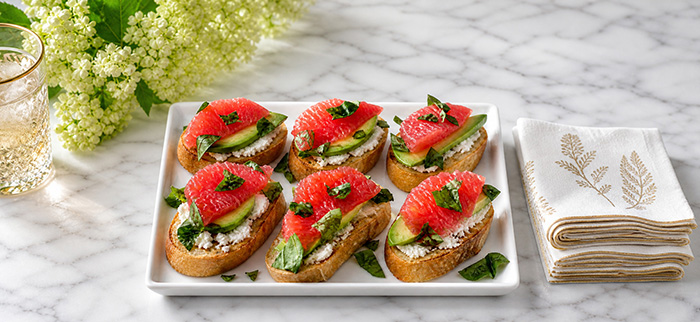
Tomato toppings came much later, in the 18th century. While they had arrived in Europe from the New World in the 16th century, they were presumed toxic and used only as houseplants (photo #5). After an 18th-century famine caused Italian peasants to eat the tomatoes, Italy was able to make all things tomato, including the cuisine’s iconic red sauce (the history of tomatoes). Crostini evolved later than bruschetta, also in Tuscany, likely in the medieval to Renaissance time frame. Crostini were created as a more refined, bite-size version of toasted bread with more delicate toppings. The toppings were typically pounded, mashed, or otherwise spreadable. The name, which means “little toasts” (crosto = crust), became popular as starters topped with anchovies or sardines mashed with herbs, pâtés (capon, chicken liver, hare, mushroom, veal, venison), minced roasted meats and sausage mixtures, salt cod (baccalà) whipped or mashed with oil, and in coastal regions, tuna preserved in oil. Cheese, a major component of Renaissance tables, also appeared on crostini: spread fresh cheeses or shaved aged cheeses, either one mixed with herbs, honey, and/or spices. Nut spreads included almond or walnut paste, sometimes combined with garlic, spices, and vinegar. Vegetable spreads included herb pastes (think pesto) and cooked greens and alliums (the onion family), chopped, seasoned, and cooked down. Needless to say, well-to-do households had broad choices, with access to luxury ingredients such as almonds, game, and spices. Following the photo: Bruschetta in America. In the 1980s, Italian restaurants, traditionally purveying red-sauce classics, began to become more regional and “authentic.” Northern Italian specialties began to appear: Risotto alla Milanese (saffron rice), Ossobuco (braised veal shank), Cotoletta alla Milanese (breaded veal cutlet), and Pesto alla Genovese. The mid-1990s–2000s saw a boom period with: Bruschetta became a default appetizer—easy and inexpensive to prepare, crunchy and appealing. The popularity of restaurant bruschetta expanded to the home beginning in the late 1990s, with the arrival of jars of chopped tomato topping ready to top toasted bread. In addition to the classic recipe—diced tomatoes, olive oil, basil, minced garlic, salt, and black pepper—balsamic vinegar was often added for tang. Other inclusions could include shredded Parmesan cheese, olives, or sundried tomatoes. Brands like Delallo and Classico sold it in plastic containers, and club store brands like Costco/Kirkland sold it in huge tubs. But it wasn’t called “bruschetta topping,” just “bruschetta.” Not only was it perceived as healthy, but it became popular party fare, either as pre-topped slices or in a bowl with different dippers. Positioned like salsa—ready to spoon onto bread, crackers, chicken, or anything—many Americans mis-learned the meaning of “bruschetta” as the tomato topping itself, not the grilled bread underneath it. Show your superior knowledge and don’t allow the term to be distorted: The word bruschetta refers to the grilled bread, the tomato mixture is bruschetta topping. Historically, the toppings for bruschetta (rustic) and crostini (refined) differed, based on the size and density of the bread. To recap: Traditional Bruschetta Toppings Traditional Crostini Toppings While grapefruits are in still season, make this colorful and flavorful Grapefruit Bruschetta recipe, inspired by one we tried from Sunkist (photo above). We especially like it with a glass of Sauvignon Blanc, which often has complementary grassy/herbal or grapefruit notes. See the †footnote for Sauvignon Blanc tips. If you’re not a blue cheese fan, substitute goat cheese or feta. Ingredients For 8 Servings 1. PREHEAT oven to 450°F. Place the baguette slices on a baking sheet and brush both sides with olive oil. Place in the oven and bake for 5-6 minutes, flipping halfway through. Remove from the oven. 2. SPREAD the slices with the cheese. If desired, sprinkle with pepper. Then top with 1/2 teaspoon of the red onion and a slice of avocado or cucumber. 3. MIX together grapefruit and basil in a small bowl. Spoon onto the baguette slices and top with a light honey drizzle. Any of these recipes can be prepared as bruschetta or crostini, depending on whether you prefer to grill or toast the bread. Turn bruschetta into open-face sandwiches for breakfast or lunch by using regular loaves of bread. Cut the slices in half, as the blogger BevCooks.com did in the photo above, with the most delicious-looking bruschetta we’ve seen in a while. You can also make “breakfast bruschetta” by placing eggs and breakfast meats atop the toast. Add a dab of garnish (diced tomatoes, fresh herbs, sliced green onions, a strip of roasted red pepper, etc.). Does ketchup count as a garnish? Well, this is America…. ________________ Pane francese. Many Italian bakeries sell loaves of pane francese, (French bread). These are essentially baguettes made with Italian flour, often resulting in a slightly less crisp crust than the French version. French baguettes use a specific type of wheat flour and a very high-protein starter to get that airy paste. Italian breads like the sfilatino and filone (next point) prefer a denser crumb that can stand up to being dipped in soup or dipped in olive oil without falling apart. Filone, the “everyday Italian loaf,” is thicker and much wider than a sfilatino or baguette. It is what’s sold in the U.S. as “Italian bread.” If you cut thick, diagonal slices from a filone, you have the perfect base for bruschetta. †Sauvignon Blanc takes on two different flavor profiles depending on where it is grown. Both styles work with the grapefruit crostini. Regions that commonly show grapefruit/citrus notes include the Loire Valley, France (especially Sancerre & Pouilly-Fumé), California (Napa, Sonoma, Lake County), Chile (Casablanca Valley, San Antonio/Leyda), South Africa (Elgin, Walker Bay, Darling), Italy (Friuli, Alto Adige), and Spain (Rueda—often in blends). Regions that commonly show grassy/herbaceous notes include Bordeaux, France (Graves/Pessac-Léognan), Marlborough, New Zealand, and Australia (Adelaide Hills, Tasmania). Some sub-regions can show the “opposite” flavors, so check the label notes. CHECK OUT WHAT’S HAPPENING ON OUR HOME PAGE, THENIBBLE.COM. |
||